If cozy were a town, it might look exactly like this. Just half an hour’s drive from Gothenburg lies Alingsås. It’s the kind of town we sometimes choose for a simple weekend escape.
Long, relaxed walks without a plan, browsing small shops, and settling into a café for fika that somehow always tastes better here.


We drove to Alingsås from Gothenburg, a trip of no more than 50 minutes, with just about 45 kilometers separating the two cities. Our visit happened during the Christmas season, and the town was wrapped in festive decorations and soft lights.
Even without snow — something quite typical for southwest Sweden — Alingsås still felt magical and cozy.
Interestingly, Alingsås thrived as a textile and garment manufacturing hub for three centuries. However, by the late 20th century, it had transformed into a tourist center. Visitors from various European countries flock here throughout the year.


Festivals in Alingsås
Each October, Alingsås hosts the annual Festival of Lights, one of the largest light art festivals of its kind in Europe. During the event, renowned light designers from around the world transform the town into an open-air gallery, using creative lighting installations to illuminate streets, parks, and historic buildings.
Another beloved annual event is the Potato Festival, held in the town’s central square at the monument to Jonas Alströmer, a native of Alingsås. He introduced potatoes to Sweden and started a textile factory that later became one of Sweden’s largest.
During the festival, cafés and restaurants serve a wide range of potato dishes, delighting food lovers.


Explore Alingsås Old Town
What I love about Alingsås is how beautifully it has preserved its wooden houses and old-town feel. The Lillån River runs through the town, and the center is easy to walk around, with cozy courtyards and small shops.
One place we especially enjoyed stopping by was Lappat & Klart, a cozy interior design store tucked away at Kungsgatan 37C — exactly the kind of place that makes wandering here feel special.
Apart from fascinating handmade crafts by local artisans, we were drawn to a Christmas lottery – a fun surprise gift for 100 kronor, with values ranging from 100 to 499 kronor.
Our surprise turned out to be a candle, which I lit the same evening upon returning home to Gothenburg. It will remind me of our lovely and cozy trip to Alingsås.


A Cozy Afternoon at Nygrens Café
It’s easy to see why fika culture brings so many people to Alingsås. Often called Sweden’s fika capital, the town is full of cafés and bakeries along its cobblestone streets and wooden houses. There are around thirty cafés here, some open since the late 1800s.
For coffee lovers, it truly feels like a small paradise. By mid-afternoon, we were quite hungry too; that’s how we ended up at Nygrens Café.
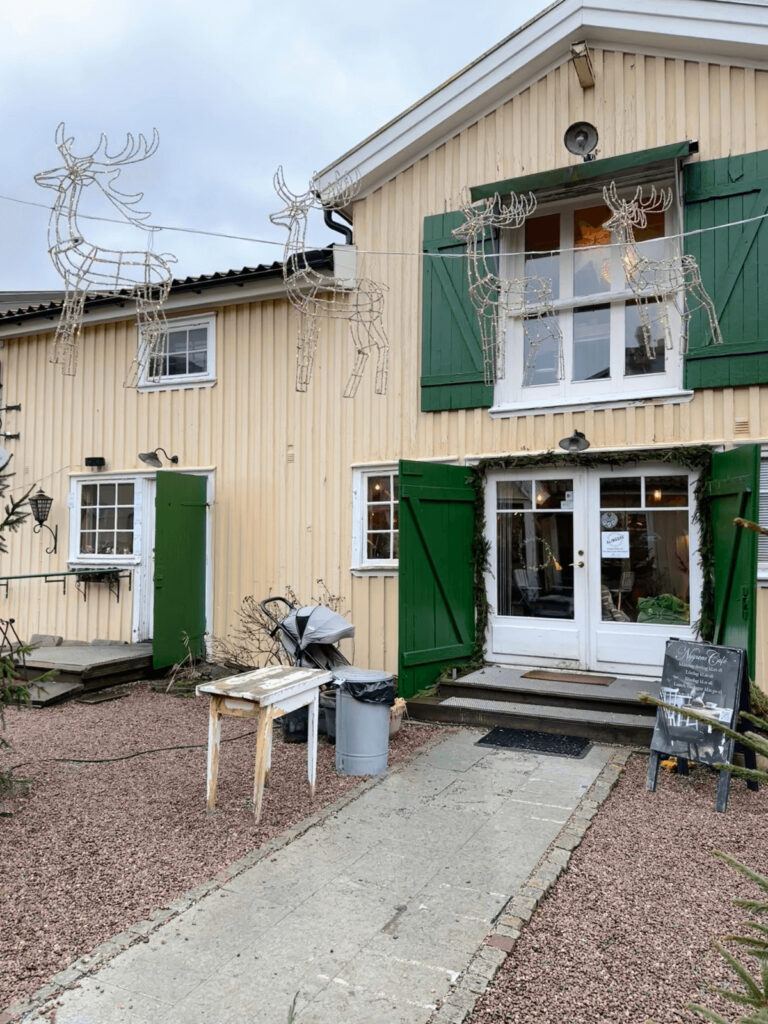
Tucked away in one of Alingsås’ oldest courtyards, Nygrens Café felt like stepping into a charming time capsule. The café, housed in a historic 18th-century building that once served as both an inn and a trading post, exudes vintage charm.
Walking in, I was immediately struck by the inviting atmosphere; the mix of rustic brick walls, vintage stick-back chairs, and elegant velvet sofas created a warm and cozy vibe. Crystal chandeliers hanging overhead added just the right touch of sophistication.
The café offers homemade pastries and cakes, old and new Swedish classics, and savory sandwiches made from their freshly baked bread.


For lunch, we ordered classic Swedish sandwiches, one topped with skagenröra, a creamy seafood mix of shrimp, mayonnaise, dill, and lemon, and another one with tuna. It was served on the café’s freshly baked rye bread, and honestly, it was one of the best I’ve had. The flavors were rich yet refreshing, and it paired perfectly with a cup of coffee.
If you’re ever in Alingsås, Nygrens Café is a must-visit, perfect for a quiet fika, a long catch-up with friends, or simply indulging in homemade treats surrounded by history.
Christinae Church in Alingsås
In the heart of Alingsås stands Christinae Church, one of the town’s most prominent historic landmarks. The church was built in the 17th century and named after Queen Kristina, who contributed 100 silver daler to its construction.
Built between 1642 and 1651, it features classicist architecture with a full-width chancel and a three-sided apse. Inside, visitors can admire remarkable 18th-century oil paintings, including Christ Taken Down from the Cross and Mary and John at the Cross of Christ.


Visiting Alingsås in Winter
December days in Sweden are short. By 3:26 PM, the sun had already set, and Alingsås lit up with Christmas lights, creating a fairy-tale-like and romantic ambiance. However, remember that most public places, shops, and cafés close shortly after sunset.
If you plan to visit Alingsås during the Christmas season, make sure to explore and dine before 3 PM. Even with the short winter days, the town feels warm and inviting, and the Christmas lights make every walk feel a little special.


How to Get to Alingsås
Alingsås is an easy day trip from Gothenburg. The simplest option is to take a train from Gothenburg Central Station to Alingsås. The journey takes around 30–40 minutes, and Alingsås station is right in the town center, so you can start exploring as soon as you arrive. hours.
If you’re driving, Alingsås is about 45 kilometers northeast of Gothenburg, and the journey usually takes around 45–50 minutes. This is how we traveled there, and having a car also makes it easy to combine Alingsås with other places in the surrounding area.
You can also reach Alingsås by bus, although the train is generally the more convenient option when traveling from central Gothenburg.
You Might Also Like:
➡️ Things to Do on Tjörn Island
➡️ Haga Gothenburg: Best Things to See and Do
➡️ Explore Varberg Like a Local
About the author:

Hello and welcome! I’m Victoria, a travel writer and the creator of Best Kyiv Guide. I spent years working as a private tour guide in Kyiv, sharing the city’s history and everyday life with visitors. I now live in Sweden and write about the places I explore firsthand, sharing personal travel experiences, practical tips, and stories from Sweden, the Baltics, and across Europe.