
| Location | Lavrska St, 27, Kyiv, Ukraine |
| Dedication | Victory over Nazism in WWII |
| Constructed | 1979-1981 |
| Artist | Vasil Borodai |
| Architectural style | Socialist Realism |
Table of Contents:
The Motherland Monument dominates Kyiv’s skyline, a colossal statue that reflects the city’s complex history. Rising 102 meters high and weighing 560 tons, it portrays a woman holding a sword and shield. Originally built as a Soviet war memorial, now often seen as representing the strength and courage of the Ukrainian people.
Key Facts About the Ukrainian Motherland Monument

Standing 102 meters tall and weighing about 450 tonnes, the monument dominates Kyiv’s skyline and even surpasses the Statue of Liberty in height.
The immense stainless-steel figure holds a 16-meter sword and a 13-by-8-meter shield and was assembled using specialized 100-meter cranes.
- The monument’s construction utilized steel from Zaporizhzhia and assembled
in Kyiv, using a 100-meter crane, with guidance from the Yevgeny Paton Institute of Electric Welding. - The monument is designed to withstand even a 9-point earthquake and is expected to last over 150 years.
The monument was originally planned to reach 108 meters but was reduced to 102 meters because of the nearby Great Bell Tower of the Kyiv Pechersk Lavra.
From Soviet Symbol to National Icon

The Motherland Monument was originally built as a tribute to the Soviet victory in World War II, designed to embody and project the ideals of Soviet ideology. The monument was part of a larger project called the “Museum of the Great Patriotic War”, which aimed to commemorate the heroism and sacrifice of the Soviet soldiers and civilians who fought against the Nazi invaders in 1941-1945.
The idea for the Motherland Monument took shape in the 1970s, when Moscow sculptor Yevgeny Vuchetich envisioned a towering female figure gleaming in sunlight, covered in a layer of gold. After he died in 1974, the project was taken over by Vasyl Boroday, a celebrated Ukrainian artist who brought the vision to life.
Borodai worked on this complex for seven years with a team of architects and sculptors. The concept was marvelous and challenging to implement, requiring consideration of the complex terrain.
Vasiliy Borodai – “I wanted to do no worse than the known examples”.
Vasiliy Borodai (1917-2010) – Ukrainian sculptor and academician of the Academy of Arts of Ukraine.
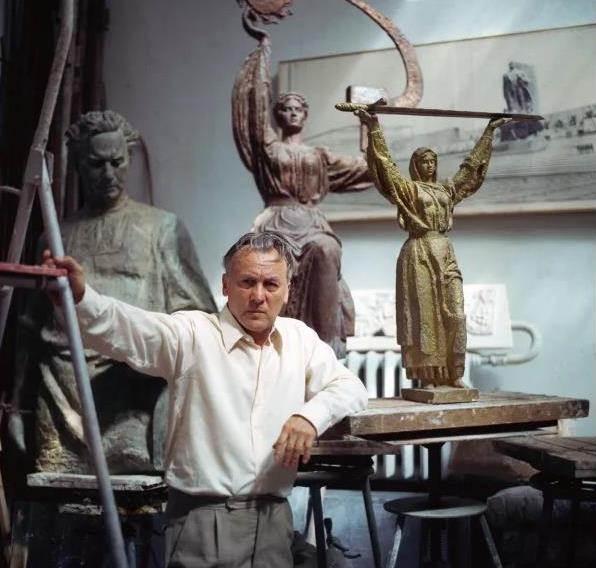
During WWII, he was a reconnaissance company commander. Throughout the war years, he never gave up hope of dedicating his life to creativity.
According to the artist’s memories, during the war years in Iași, Romania, he found sketches of an unknown artist in a ruined house. “It was like a jolt hit me. I wanted to create” Vasiliy Borodai recalled this event.
“This sculpture is a significant achievement of our Ukrainian science, a synthesis also known in the art of the past. There are famous engineering calculations by Leonardo [da Vinci], Michelangelo. But there are few such examples, and not many in modern art either – the Statue of Liberty in New York, Christ in Rio de Janeiro, and the Great Buddha in Japan. So, a unique opportunity arose, a kind of challenge of the time. I wanted to do no worse than the known examples.” said Vasiliy Borodai.
The Motherland Monument’s Makeover: Trident and Decommunization

On July 13, 2023, Ukraine took a symbolic step toward disassociating itself from its Soviet past by officially approving the decommunization of the iconic Mother Motherland monument. The Soviet coat of arms on the monument’s shield was replaced with the Ukrainian trident.
The new coat of arms was produced by Metinvest, a Ukrainian mining and metallurgical company. Work on the installation began in July and was timed to finish by August 24, 2023—Ukraine’s Independence Day. The project cost was set at 28 million hryvnias.
At first, the Zaporizhstal Iron and Steel Works was set to supply the metal for the new trident. However, tests by the Shimanovsky Institute of Steel Structures, which oversees the strength and aerodynamics of large steel projects, found the material unsuitable.
This decision stirred up some controversy, with Zaporizhstal’s team questioning whether the institute’s claims were fair and accurate. In the end, they went with Belgian steel because it met the requirements for thickness and color. The final dimensions of the trident were 4.5 meters by 7.5 meters, with a weight exceeding 400 kilograms, similar to the previous coat of arms.
Fifteen companies, including Nova Poshta and Persha Pryvatna Brovarnya, stepped forward as sponsors for the project.
The decommunization process began with partially dismantling the Soviet coat of arms on July 30, 2023. On August 6th, the Ukrainian trident was proudly installed on the monument.
Is the Motherland Monument Still Standing?
Yes, the Motherland Monument in Kyiv is still standing. The statue, a 62-meter (203-foot) high steel sculpture of a female warrior, has been a prominent landmark in the Ukrainian capital since its construction in 1981.
Public Debates and Perspectives on the Monument

On July 29, 2023, the director of the National Museum of the History of Ukraine in the Second World War, Yuriy Savchuk, announced that the monument “Mother Motherland” was planned to be renamed “Ukraine Mother” by August 24.
Government officials delayed the process for over a month, leaving the task unfinished. Then, on August 27, Acting Minister Rostyslav Karandeyev announced—without offering any explanation—that no official decision on the renaming had been made.
Removing Soviet symbols like the hammer and sickle and replacing them with the Ukrainian trident has sparked debate, especially with the country facing war and economic struggles. Many question whether this is the best use of resources right now.
Is the monument’s symbolic significance worth the expense at a time when resources are scarce and the focus should be on immediate survival?
The Monument’s Enduring Relevance

Despite the debates, the Motherland Monument remains one of Kyiv’s most important cultural landmarks, drawing visitors from around the world. Its recent decommunization—the replacement of the Soviet emblem with Ukraine’s trident—has given the statue a new meaning.
Today, it stands not only as a memorial to the past but also as a powerful symbol of Ukraine’s independence and determination to shape its own future.
About the author:

I spent years working as a private guide in Kyiv. Today I live in Sweden, where I explore Scandinavia and Northern Europe by car, ferry and train. I continue to write about Ukraine on my blog and my travel experiences and insights in Sweden and the Baltics.
Kyiv is an incredible city! I visited earlier this year and had an amazing experience. The city is gorgeous (I like to think of it as the Paris of Eastern Europe), with stunning churches, fascinating museums, unique art, and really moving memorials. The culture is lively and you can even take a day trip to chernobyl, which is a must-see!
Plus, Ukraine is super affordable. You can get a beer at a bar for just $1, meals for around $10, and cheap metro rides. It’s definitely a great time to visit after the war finish!
Thank you very much for your kind words!
The author of the monument “Motherland” in Kyiv is Evgeniy Viktorovich Vuchetich, he is the author of the monuments: “Beat swords into ploughshares”, installed near the UN building in New York, the monument “Soldier-Liberator” in Treptower Park in Berlin, “Motherland” in Volgograd.
Vasily Zakharovich Borodai, only completed this project, shortening the statue’s sword and reworking the podium, also refused to cover it with gold leaf.
Attributing the authorship to Borodai is incorrect, he is a talented sculptor, but he only completed what he started.
Thank you for stopping by and leaving a comment. But may I kindly ask you if you have really read the article? Because in it I provide the information about the authors and artists who worked on the monument.
It is August 2026 and it is still difficult to travel to Ukraine. I cannot fully understand what you and your country is going through. All I can say is that the Ukrainian people are courageous. And thank you for showing how a communist symbol has been removed and replaced with the tryzub (trident). I hope in the future that we have peace and people can visit Ukraine as tourists.
Thank you very much for your kind words and your support. We never forget those who supported us in these dark times for Ukraine.